Saturday, 7 January 2012

ON THIS DAY in 1536: The Death of Queen Katherine of Aragon

On this day in 1536, the death of Queen Katherine of Aragon.
Romanticized drawing of Katherine of Aragon at the time of her death
Katherine was the first wife and queen of King Henry VIII. She was born Infanta Catalina de Aragón on 16 December 1485, the youngest daughter of King Ferdinand II of Aragon and Queen Isabella I of Castile; the great Catholic monarchs who united the kingdoms of Aragon and Castile. She was married to Arthur, Prince of Wales, eldest son and heir of King Henry VII of England and his consort Princess Elizabeth of York on 14 November 1501. Soon after the marriage Arthur died on 2 April 1502 in Wales.

On the 25th of June 1503, she was formally betrothed to the king's second son, Henry, now prince of Wales, and a papal dispensation for the alliance was obtained. They were married on 19 June 1509 and Katherine was crowned queen on the 24th.

Katherine's marriage to Henry was joyful and happy for more than a few years; but after "her" failure to produce a male heir, Henry started to stray from his wife. On 15 June 1519, Henry's mistress Bessie Blount had given birth to the King's illegitimate child; a boy also named Henry. As the King acknowledged the child he was given the surname Fitzroy (meaning son of a king) and was given numerous titles and estates. For awhile there was talk that Fitzroy might become the heir to the throne, but Henry already had an heir by his wife Katherine; a girl named Mary. By 1526, Katherine's health deteriorated and it was generally accepted that she could not have any more children. [for more info on this topic, click -- Childbearing; A Tale of Katherine of Aragon]

Fast forward, Henry has more affairs and falls in love with an English commoner named Anne Boleyn. Anne was the sister of Henry's former mistress Mary. Henry would go to hell and back just to divorce Katherine and marry Anne. This whole ordeal created friction at the court and abroad; Katherine's nephew was now Charles V, the Holy Roman Emperor. Long story short -- after a trial it was determined that Katherine and Henry had been living in sin and the marriage was null and void.


Henry married Anne and Katherine was titled Princess Dowager while her daughter Mary was bastardized and her status as Princess was revoked. Although the marriage was never seen as valid in the Catholic Church, within Henry's Church of England the marriage was valid. She was kept in strict seclusion, separated from her daughter Mary, and from all outside communication. In December 1535 her health started to deteriorated and on 7 January 1536 she died at Kimbolton Castle. By the King's command she was buried at Peterborough Cathedral.

Tomb of Queen Katherine of Aragon, Peterborough Cathedral
 The following day, news of her death reached the king. There were rumors at the time that she was poisoned[1][2][3], possibly by Gregory di Casale.[4] Rumors also circulated that Katherine had been poisoned by Anne or Henry, or both, as Anne had threatened to murder both Katherine and Mary on several occasions. The rumors were born after the apparent discovery during her embalming that there was a black growth on her heart that might have been caused by poisoning.[7] Modern medical experts are in agreement that her heart's discoloration was due not to poisoning, but to cancer, something which was not understood at the time. According to the chronicler Edward Hall, Anne Boleyn wore yellow for the mourning, which has been interpreted in various ways; Polydore Vergil interpreted this to mean that Anne did not mourn.[5] However, Chapuys reported that it was actually King Henry who decked himself in yellow, celebrating the news and making a great show of his and Anne's daughter, Elizabeth, to his courtiers.[6] This was seen as distasteful and vulgar by many. Another theory is that the dressing in yellow was out of respect for the late queen-princess dowager as yellow was said to be the Spanish color of mourning.

Before her death, Katherine wrote a final letter to her husband the King.

Last Letter to Henry VIII, January 7, 1536 
Written shortly before her death, Katherine of Aragon's last letter to the man she still considered her husband was more a tender farewell than a bitter recrimination. 
 
M y most dear lord, king and husband,

The hour of my death now drawing on, the tender love I owe you forceth me, my case being such, to commend myself to you, and to put you in remembrance with a few words of the health and safeguard of your soul which you ought to prefer before all worldly matters, and before the care and pampering of your body, for the which you have cast me into many calamities and yourself into many troubles. For my part, I pardon you everything, and I wish to devoutly pray God that He will pardon you also. For the rest, I commend unto you our daughter Mary, beseeching you to be a good father unto her, as I have heretofore desired. I entreat you also, on behalf of my maids, to give them marriage portions, which is not much, they being but three. For all my other servants I solicit the wages due them, and a year more, lest they be unprovided for. Lastly, I make this vow, that mine eyes desire you above all things.

Katharine the Quene.

References
  1. Letters and Papers of the Reign of Henry VIII, vol. X, no. 190
  2. Letters and Papers of the Reign of Henry VIII, vol. X, no. 59
  3. Letters and Papers of the Reign of Henry VIII, vol. X, no. 230
  4. Letters and Papers of the Reign of Henry VIII, vol. X, no. 200
  5. Warnicke, p. 187.
  6. Warnicke, p. 188.
  7. Lofts, p.139.
    © 7 January 2012
    Meg McGath 

    Friday, 6 January 2012

    ON THIS DAY in 1588: The Birth of Lady Elizabeth Stanley (6 January)

    Lady Elizabeth Stanley, Countess of Huntingdon, Lady Hastings of Hungerford and Lady Botreaux (6 January 1588 – 20 January 1633)

    Lady Elizabeth was born and baptised on 6 January 1588,[1] in Knowsley, Lancashire, the third and youngest daughter, and co-heir of Ferdinando Stanley, 5th Earl of Derby, Lord of Mann, (1559-April 16, 1594) and Alice Spencer (4 May 1559 -January 1637) Her paternal great-grandmother was Lady Eleanor Brandon, Countess of Cumberland, daughter of Princess Mary Tudor, Dowager Queen of France and Sir Charles Brandon, 1st Duke of Suffolk. Another paternal great-grandmother was Lady Dorothy Howard, daughter of Sir Thomas Howard, 2nd Duke of Norfolk and his second wife, Agnes Tilney.

    As the great-great-granddaughter of Princess Mary Tudor, Duchess of Suffolk, the younger sister of King Henry VIII, Elizabeth became, after the death of her grandmother, Lady Margaret Clifford in 1596, third in line of succession to the English throne. Her father, Ferdinando, had died before his mother. Upon the death of Queen Elizabeth I in 1603, Elizabeth and her older sisters, Lady Anne Stanley, Countess of Castlehaven, heir presumptive, and Lady Frances Stanley were passed over in favour of King James VI of Scotland, who was descended from King Henry's elder sister Margaret Tudor.

    She was one of the dancers in Ben Jonson's, The Masque of Queens performed at Whitehall Palace in 1609.

    Shortly after her 13th birthday, she married Henry Hastings (1586-1643), later the 5th Earl of Huntingdon, only son of Francis Hastings, Baron Hastings and Sarah Harrington on January 15, 1601. As his father had died in 1595, Henry was heir to the earldom of Huntingdon. On 31 December 1604, upon the death of his grandfather George Hastings, 4th Earl of Huntingdon, he succeeded as the fifth earl.

    They made their principal home at Ashby de la Zouch Castle, Leicestershire, where the earls of Huntingdon had their family seat. Together Henry and Elizabeth had four children:[2][3]
    • Lady Alice Hastings (1606–1667), married Sir Gervase Clinton; died childless.[3]
    • Ferdinando Hastings, 6th Earl of Huntingdon (18 January 1608- 13 February 1655), married Lucy Davis, by whom he had issue.[3]
    • Lord Henry Hastings, 1st Baron Loughborough of Loughborough (28 September 1610- 10 January 1667), died unmarried without issue.[3]
    • Lady Elizabeth Hastings (born ca. 1605), married Sir Hugh Calverley; died childless.[3]
    Lady Elizabeth was a patron of the arts, as well as a writer. She was the author of five Huntington Library manuscripts: four copies of prayers, biblical extracts, and meditations, and one volume of sermon notes. Forty-six of her letters (written from 1605 until late 1632), which provide a keen insight into her life and personal sentiments, survive in the Hastings Collection of the Huntington Library. In one of these letters, she described a visit to the royal court where she watched the rehearsals and final production of a masque, at which she was kissed by both King James and Queen Anne.

    Her miniature portrait by Nicholas Hilliard was painted sometime between 1601 and 1610. She was also the subject of a portrait by Paul van Somer painted in about 1614.

    Tomb of Alice Spencer, Countess of Derby which depicts her three daughters L to R: Anne, Frances and Elizabeth
    Elizabeth died on 20 January 1633 shortly after her 45th birthday at Whitefriars, London at the home of her brother-in-law, John Egerton, 1st Earl of Bridgewater. A procession took her body to the parish church of St. Helen in Ashby-de-la-Zouch where she was buried on 9 February. The minister praised her in conventional terms, but he also mentioned her literary activities. The four manuscripts of her religious writings represented her thoughts right up to her death; in three of her four manuscripts, her final meditation was Of Death. Her husband died 10 years later in 1643.

    References

    Tuesday, 27 December 2011

    Book Review -- "The Royals" by Leslie Carroll


    This book was a major disappointment and had major flaws in The Tudors section. First off, Henry VII was basically skipped over, no picture -- the Tudors section starts with the portrait of Elizabeth I. According to the author "Henry Tudor's blood was barely blue being five generations from Edward III" and "Henry was not born to the crown" -- the latter being true, but to skip such an important figure along with Elizabeth of York is unforgivable.

    Image thought by some, uh who, to be Anne Boleyn
    Another major error was the portrait of Anne Boleyn; the style of the clothes and hair is from the late 16th/early 17th century - Anne would not have worn the 'Elizabethan collar'. It may be a modern interpretation, but to use it as the sole portrait of Anne is rather odd.

    I also disliked how Catherine Parr's section was full of errors and made her look like a harlot after the death of Henry VIII.

    First off, there is no proof that Catherine was romantically involved [meaning sleeping with] with Thomas Seymour before the death of Lord Latimer or before the marriage of Henry and Catherine. Also, Thomas was sent away on business for the king, he didn't make himself scarce.

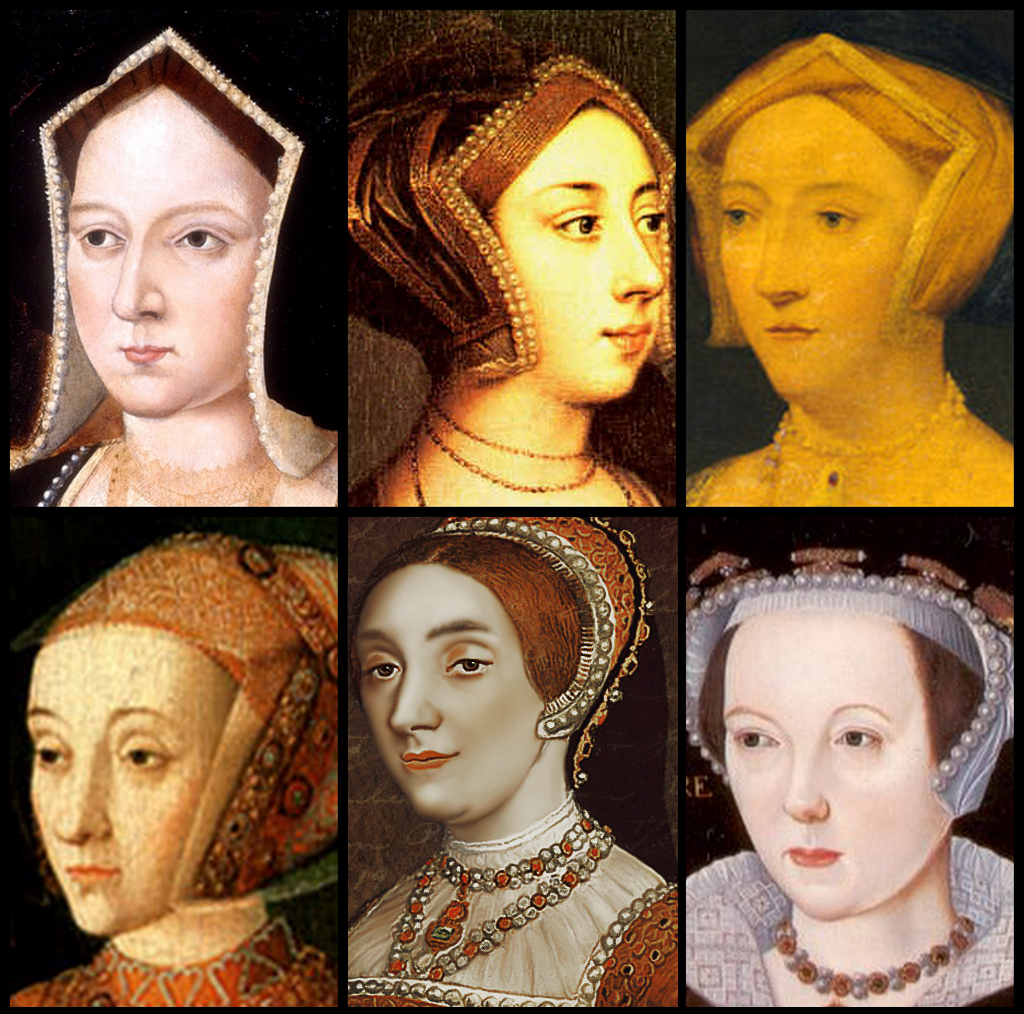
    The statement that four out of six wives were redheads is incorrect.

    Historians are not 100% sure that Catherine was part of Lady Mary's household.

    The discussion of theology became a problem when Catherine started preaching to the King -- after the whole scandal they continued talking about religion, but it was more toned down.

    I'm not sure where the info is coming from that Henry told his physician that he wanted to "get rid of" Catherine Parr. There were rumors, set up most likely by the Catholics at court, which also included Henry wanting to marry the Dowager Duchess of Suffolk, Queen Catherine's friend, who was even more prone to speak her mind when it came to matters of religion. There was no doctor involved in telling Queen Catherine about Henry's intentions. A warrant was drawn up which was taken to Queen Catherine. She went to King Henry arguing that she was "but a woman" and that she was merely trying to distract the King from his infirmities.

    Catherine pushed Henry's wheelchair in the gardens?? The correct info has the two sitting in the garden when they were approached by Henry's guards.

    The Queen Dowager, Catherine, waited a few MONTHS, not weeks, before re-entering into her "relationship" with Seymour. I don't think Catherine would have been that disrespectful, but just to be clear -- the King gave her the go ahead to re-marry who she wanted. They were thought to be married in the spring months, possibly May of that year.

    Where the statement that Catherine was acting like a "trollop" came from, I would love to know. Seymour asked the King for permission to marry the Dowager Queen. Yes, Lady Mary was upset and thought Catherine should have waited a tad longer but in the two biographies I've read on Mary (Anna Whitelock and Linda Porter) she never once called Catherine a trollop. In fact, Mary disliked Seymour more than anything as he pestered her about matters of state. Mary eventually came to forgive Catherine -- Catherine received a letter from Mary while she was pregnant and Catherine named the baby girl after her step-daughter.

    The stories of Seymour and Elizabeth are quite interesting and many theories have been put out there, but what actually happened in that household is another story as Elizabeth's lady, Kat Ashley, was the main contributor to the testimony. Kat herself encouraged Elizabeth to flirt with Seymour and had a crush on him herself. "But the doctor's dirty hands caused an infection"... there are many contributing factors to the fever that caused Catherine to die, much like the death of Jane Seymour. And the last sentence of Lady Jane being raised as a surrogate daughter -- she was a ward. This book and this chapter reads more like a romance novel then an actual history book.

    The author put an actual biography of Catherine Parr (Susan James) within her chapter full of sources that is actually well respected; perhaps the author should have actually read the book before "quoting" it.

    The chapter on The Tudors reads more like a romance novel than a history book; that might explain why the author chose the "romanticized" portrait of Anne Boleyn. No citations are given as to where the info comes from and major mistakes were made. The only good thing about the book is the reproduction of one of Anne Boleyn's letters and the letter from Katherine Howard to Master Culpepper.

    One positive note the author made about Catherine Parr:

    "Perhaps the most mature and educated of Henry's wives." 

    So why did she paint Catherine as such a "trollop"?? You've got me! Other then that, don't waste your money. Historically inaccurate indeed!

    Wednesday, 14 December 2011

    English Ancestry of the Six Wives; descent from Edward I of England

    The multiple descending lines from Edward I of England for the SIX wives of King Henry VIII:

    The English descent of ALL SIX Queens consort's of Henry VIII
    Yes, all six wives had English ancestry; some more than others. 
    Would it surprise you to know that even Katherine of Aragon and Anne of Cleves had Edward I in their pedigree? 

    In fact, Katherine of Aragon descended from two wives of Prince John of Gaunt, 1st Duke of Lancaster, Titular King of Castile [the son of Edward III of England and Philippa of Hainault]; Blanche of Lancaster AND Constanza of Castile, heir to the throne of Castile.
    1. Katherine of Aragon - daughter of Ferdinand II of Aragon and Isabella I of Castile [2 times]
    • By her mother, Isabella of Castile's paternal grandmother, Katherine of Lancaster, daughter of Prince John of Gaunt [son of Edward III] [and Constanza of Castile], she descended from Edward I and Eleanor of Castile.
    • By Isabella of Castile's maternal great-grandmother, Philippa of Lancaster, daughter of Prince John of Gaunt [and Blanche of Lancaster], she descended from Edward I and Eleanor of Castile. [Hampton Court Pedigree shows this line from Edward I's son, Edward II, onwards]
         2.  Anne Boleyn - daughter of Sir Thomas Boleyn and Lady Elizabeth Howard [5 times]

    • By both paternal great-great-grandparents, Sir James, 4th Earl of Ormonde and Joan Beauchamp; she descended from Edward and Eleanor's daughter Elizabeth of Rhuddlan.
    • By her paternal great-grandmother, Anne Hankford, she descends from Elizabeth's elder sister, Joan of Acre.
    • By her maternal [Howard] line she descended from Edward I and Eleanor; again by Elizabeth of Rhuddlan, by way of Lady Eleanor Fitzalan [wife of Sir Thomas Mowbray, 1st Duke of Norfolk].
    • By Sir Thomas Mowbray, 1st Duke of Norfolk, she descended from Edward I and Marguerite of France through their son, Thomas of Brotherton Plantagenet, Duke of Norfolk [Hampton Court Pedigree shows this line from Edward I's son, Thomas of Brotherton onwards]
         3.  Jane Seymour - daughter of Sir John Seymour and Margery Wentworth [twice]

    • By her maternal great-grandmother, Hon. Margaret Clifford, whose father John Clifford, 7th Lord descended from Joan of Acre, daughter of Edward I and Eleanor of Castile.
    • By Margaret Clifford's mother, whose mother descended from Edward III of England by his second son, Lionel of Antwerp. [Hampton Court Pedigree shows this line from Edward I's son, Edward II, onward]
         4.  Anne of Cleves - daughter of John III, Duke of Cleves and Marie von Julich [twice]

    • By both great-grandparents, Johan I of Cleves and Elizabeth of Nevers; who were great-grandchildren of Marguerite of Dampierre, suo jure Countess of Flanders. Marguerite was the great-granddaughter of Margaret of England, Duchess of Brabant; daughter of Edward I and Eleanor. [Hampton Court Pedigree shows the lineage of Johan I of Cleves from Edward's daughter, Margaret of England]
         5.  Katherine Howard - daughter of Lord Edmund Howard and Jocasa Culpepper [3 times]

    • Like Anne Boleyn, by her paternal line [Howard] she descended from Edward I and Eleanor by, Elizabeth of Rhuddlan, by way of Lady Eleanor Fitzalan [wife of Thomas Mowbray, 1st Duke of Norfolk].
    • By Sir Thomas Mowbray, 1st Duke of Norfolk, she descended from Edward I and Marguerite of France through their son, Thomas of Brotherton Plantagenet, 1st Duke of Norfolk [Hampton Court Pedigree shows this line from Edward I's son, Thomas of Brotherton onwards]
    • By her maternal great-great-grandfather, Sir William Ferrers, 5th Baron Groby, she descends from Joan of Acre, daughter of Edward I and Eleanor.
         6.  Katherine Parr - daughter of Sir Thomas Parr of Kendal and Maud Greene [6 times]

    • By her paternal great-great-grandfather, Sir Richard Neville, 5th Earl of Salisbury; she descends from Edward I and Eleanor by their son Edward II of England. [Hampton Court Pedigree comes from this line coming from Edward I's son, Edward II onwards]
    • By her paternal great-great-grandmother, Alice Montacute, suo jure Countess of Salisbury [wife of Sir Richard], by Joan of Acre, daughter of Edward I and Eleanor; and Edmund of Woodstock, son of Edward I and Marguerite of France.
    • By her maternal great-great-grandfather, Sir Thomas Greene, Sheriff of Northamptonshire she descended from Elizabeth of Rhuddlan, daughter of Edward I and Eleanor. His wife, Lady Philippa de Ferrers also descended from Elizabeth's elder sister, Princess Joan of Acre, TWICE.
    For more on their pedigrees, featuring the windows from Hampton Court Palace -- see also -- 

    Sunday, 27 November 2011

    Tudor portrait identification issues: Lady Eleanor Brandon, her daughter Margaret, or Margaret Wentworth?

    Portrait by Hans Eworth; thought to be Lady Eleanor Brandon or her daughter, Lady Margaret Clifford
    Lady Eleanor was a descendant of a member of the Tudor dynasty. In March 1533, a marriage contract was written up for Lady Eleanor and Henry Clifford, the eldest son and heir of Henry Clifford, 1st Earl of Cumberland by Lady Margaret Percy.[2] However, since her mother died nine months later, she waited to go and live with her young husband and in-laws. In anticipation of Eleanor's arrival, the Earl of Cumberland built two towers and the great gallery within Skipton Castle.[3] Eleanor married Clifford at Brandon house, Bridewell, in 1537; her uncle King Henry VIII was present.[3][4][5][6]
     
    Lady Eleanor and her husband had one surviving child, Lady Margaret, who was born in 1540. Lady Margaret would carry on her mother's claim to the throne under the final will of King Henry VIII after the Grey sisters which included Lady Jane Grey. Margaret married Henry Stanley, 4th Earl of Derby in 1554.
    The Portrait

    There is a discrepancy as to who the sitter is in the Hans Eworth portrait which is featured. The coat of arms in the top left corner, which may have been added later, are the impaled arms (those of a husband and wife) of Henry Clifford, 2nd Earl of Cumberland, and his wife Lady Eleanor, daughter of Charles Brandon, 1st Duke of Suffolk and Mary Tudor, Dowager Queen of France. As a result the painting has been frequently exhibited in the past as a portrait of Lady Eleanor, regardless of the fact that she died in 1547, well before the date of this portrait [the roman numerals MDLX at the top right = 1560]. It is, however, a rule of heraldry that impaled arms are not used by the children of a marriage, as they would have their own. Hence the later addition and erroneous use of the arms here suggests that the identity of the portrait was already unclear only two or three generations after it was painted, a situation by no means unusual amid the frequent early deaths, multiple marriages, and shifting alliances and fortunes of the most powerful families of the Tudor era. Later the portrait was thought to represent the only child of Eleanor and Henry to survive infancy, Margaret. Unfortunately the inscription on the right which might have provided a check (Margaret would have been aged 25-28 at the time of this portrait) has been truncated; although the Roman numerals of the year can apply only to 1565-8, the age of the sitter cannot be ascertained with any useful accuracy. The National Portrait Gallery has an online sketch of this portrait identified as Lady Eleanor, but the portrait remains in dispute.[5][6]

    Another unfortunate aspect of the portrait is the clothing; the clothing does not match the time period of Lady Eleanor Brandon. The dress is third quarter of the 16th century and is of Spanish influence.


    According to Richard Davey. The sisters of Lady Jane Grey and their wicked grandfather, E.P. Dutton and co., 1912:
    The Lady Eleanor Brandon was a better looking woman than her sister Frances. When her tomb in Skipton Church was disturbed in the seventeenth century her skeleton which was in perfect condition proved her to have been very tall and large boned whereas the Lady Frances was of medium stature. Lady Eleanor, if we may judge by her portrait, which hangs at Skipton Castle, was pretty rather than beautiful. The writer confesses that the portrait at Skipton did not impress him as that of one who could have put forward the slightest pretensions to good looks; the cheeks are high, the forehead abnormally broad, the eyes however are fine, and the hair fair but the complexion according to this venerable picture must have been quite ghastly. The portrait is very badly painted; a poor thing worth little as a work of art but none the less interesting.
    The site for the Tate Gallery concludes that the painting is still unidentified, yet there is an identical sketch on the site for the National Portrait Gallery identified as Lady Eleanor. Who's who?

    Another proposal for the sitter is given as Hon. Margaret Wentworth, daughter of Thomas Wentworth, 1st Baron and his wife Margaret Fortescue. Sir Thomas was a nephew of Queen Jane Seymour's mother, Margaret Wentworth. Thomas's daughter, Margaret, married three times; Sir John, Baron Williams of Thame; Sir William Drury; and Sir James Croft. The new identification is given by Dr. Roy Strong based on the comparison to her sister, Jane Wentworth, Lady Cheney [below].

    Jane Wentworth, Baroness Cheney of Toddington

    That is one of the problems of portrait identification within the Tudor era.

    Queen Katherine Parr, NPG
    Melton Constable portrait formerly labeled Lady Jane Grey; now re-labeled as Queen Katherine Parr
    For years Queen Katherine Parr's many portraits were thought to be Lady Jane Grey; it is just recently that the portrait in the NPG in London (first portrait) was finally changed permanently to Queen Katherine Parr based on the research of the Queen's inventory of jewels which was recorded in the documents of King Henry VIII. They are also recorded in the back of the recently published book, "Katherine Parr: Works and Correspondences." Those very same jewels that belonged to the Queens of England were last worn by Queen Katherine Parr. After the death of King Henry, and after Edward Seymour proclaimed himself Lord Protector, the jewels, along with her personal jewels, were put into the Tower for safekeeping. Since Edward VI had no queen the jewels would not have been in use unless Edward's wife Anne Stanhope got a hold of them; which she was not entitled to. Lady Jane Grey was in the household of Queen Dowager Katherine Parr until her death in 1548, but as stated the queen's jewels were not accessible to Lady Jane and the portrait which is dated in the early 1540s also proves that the person painted had to have possession of those jewels; and who had possession during that time -- only Queen Katherine Parr.

    So for now, the portrait remains one of four options: "unknown", "Lady Eleanor Brandon, Countess of Cumberland","Lady Margaret Clifford, Countess of Derby", or "Margaret Wentworth".

    Sources:
    3. Lawrence Manley, "From Strange's Men to Pembroke's Men: 2 "Henry VI" and "The First Part of the Contention".", Shakespeare Quarterly, vol. 54, No. 3 (Autumn, 2003), pp. 253-287.
    4. Sir Sidney Lee. Dictionary of national biography, Volume 54, Smith, Elder, & co., 1898. pg 70. Google eBook 
    5. Eleanor Clifford (née Brandon), Countess of Cumberland, probably by Alfred Thomas Derby, after Unknown artist, Purchased, 1893, Reference Collection NPG D23066. National Portrait Gallery 
    6. The Tate Gallery 1984-86: Illustrated Catalogue of Acquisitions Including Supplement to Catalogue of Acquisitions 1982-84, Tate Gallery, London 1988, pp.66-8. Tate Collections
     Written and researched by Meg McGath

    Sunday, 6 November 2011

    "Anonymous": Shakespeare who?

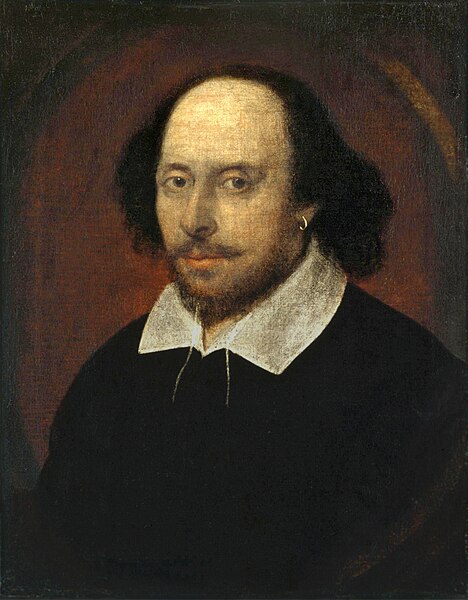
    The Chandos portrait, artist and authenticity unconfirmed. National Portrait Gallery, London.
    HD International Trailer of Anonymous

    William Shakespeare (baptised 26 April 1564; died 23 April 1616) was an English poet and playwright, widely regarded as the greatest writer in the English language and the world's pre-eminent dramatist -- or so we are told growing up. 

    Sir Edward de Vere, 17th Earl of Oxford
    The new movie that just came out, Anonymous, refutes that. We start with a CGI version of Elizabethan London. We are taken to the playhouse where a guy named Ben Jonson (an actual poet and playright) is directing his own play. In waltzes this middle aged man with a hanky in our next scene. The man walks into the theatre and sits down. He is intrigued by the play that is going on. He meets with Jonson after the play and we are introduced to the 17th Earl of Oxford, John de Vere. Who is this man and what does he have to do with Shakespeare and this Anonymous movie? 
    "William Shakespeare"
    Well, apparently there is another version of who Shakespeare really was. In short -- Shakespeare never wrote a word, is made to look like an uneducated actor who can only read but cannot write even one letter when put to the test. Jonson of whom we were talking about was supposedly first approached by the Earl who selected him to distribute his plays; which have been stacking up in his office for years. We see Jonson looking through the collection of plays which include, "The Tragedy of Romeo and Juliet" and "Julius Caesar". Now the claim that Oxford wrote all of these plays and that Shakespeare wrote nothing was droned up by the fact that the Earl of Oxford was of nobility; he was raised to become an educated man among the court of Elizabeth I. Shakespeare was basically a "peasant" of the land.

    Shakespeare crowd surfs after his successful debut
    The whole movie paints Shakespeare as an idiot who is a complete fool, is conniving, and money hungry. In one scene, after finding that Jonson has been getting his plays from Oxford he appears at Oxford's home and threatens to expose him unless he is paid money and given credit for Oxford's work. Oxford, who said he has "no wisdom" agrees. With that, some of the greatest works of "Shakespeare" or should we say "Anonymous" are brought to light and introduced to the stage. Shakespeare starts to work on the productions and all he has to do is walk out in front of the audience at the end and bow; then he can lay back and enjoy the money he's getting from Oxford to upkeep the deal. Shakespeare is even shown bringing an official coat of arms that was granted to him into a pub, which "cost a lot", but he had to have it to make himself "official". Funny thing is -- his motto -- "Non sans droict" meaning "Not without right." When Shakespeare tries to pronounce the last word he is caught fumbling; Jonson who is present has to finish and translate for the tavern folk who are questioning "what is that?" (coat of arms) If I'm not mistaken, I believe it was Shakespeare's father who was granted the arms in the first place?

    Young Queen Elizabeth with Edward de Vere, Earl of Oxford
    Anywho, the movie also revolves around the "love story" of Oxford and Queen Elizabeth. We have the young Oxford who is living under the wardship of William Cecil. Cecil gets Oxford the best tutors in all of Europe and Oxford still persists in writing poetry which is seen as the "devil's work" in Cecil's eyes. Oxford, while at court, attracts the interests of the young Queen played by Joely Richardson. The two dance and then fast forward through the love making we have Elizabeth who is now with child "again" apparently. She demands that she be allowed to marry him. Cecil quarrels with Elizabeth and sends her off to have the child, who is the bastard of Oxford obviously -- Cecil tells Oxford that he is to never see Elizabeth again and yada yada must go back to his wife, who is coincidentally Cecil's daughter, Lady Anne. Oxford is so insulted and angry that he writes a play making depicting Cecil as the character Polonius in Hamlet

    We then get into the later years where Cecil seems to have developed a faction against his own son-in-law (Oxford), the Earl of Southampton, and the Earl of Essex, Robert Devereux. William dies, but passes on everything he knows to his son, Robert. By this point, Jonson, oh yeah remember him? Jonson makes it a point to report the play Richard III and how it is possibly depicting Sir Robert.While the play is debuting, Robert Cecil feels that his character like his father before him is being made fun of by making Richard III a hunchback.  It is also during this time that Oxford decides to write a book recounting the love affair he had with the queen so that she will invite him to court; a subplot to get Essex and Southampton into see the queen. Essex, along with Southampton are found out and put in the Tower. 
    The late Queen Elizabeth agrees to meet with Oxford once more...
    Because of the book written by Oxford -- she decides that she would like to meet with him again. In comes Cecil, to spoil her newly found affections for Oxford again -- she is told that Southampton is actually her child.

    Henry Wriothesley, 3rd Earl of Southampton and his supposed father, the 17th Earl of Oxford
    As the Earl of Oxford watches Essex and Southampton being ambushed -- he is also approached by Sir Robert Cecil who starts to talk about what his father told him before he died. "My father told me all of his secrets." Ok, creepy! Turns out that when Elizabeth was about 16 or 17 (can't remember exactly), under the rule of "Bloody Mary" and yes he uses those very words.. Elizabeth becomes with child and has her first bastard. One of many to follow. What Oxford is not aware of is that HE is that child and that he has committed incest with his own mother -- whow, flashbacks of Anne Boleyn and Mary Boleyn inserted here -- in fact Cecil even made a comment about the Tudors and their selection of sexual partners were not always "the best".  Anywho, Oxford, who is in disbelief and is sickened by the very thought, is also informed that Southampton is his son by the queen. Cecil goes on in his monologue about how Oxford was taken on by his father so that he might marry his daughter and father the next heir to the throne since Oxford was the first bastard of the queen... I know right.. I'm a little weirded out and lost as to how off track the plot got. Oxford finally sees the queen who has no idea that Oxford is her son -- Oxford begs for their sons life and it is granted after she scolds him and tells him that none of his works will ever bear his name.

    Vanessa Redgrave as Queen Elizabeth I
    The queen continues to age and Cecil is determined to put James of Scotland on the throne -- in her last days an Act of Succession is written up naming James as the heir to the throne. Cecil approaches the dying queen who is staring off into space -- insists that she sign the decree -- she takes one look at it, sees James's name, and tosses it to the floor. Wham, Elizabeth is dead and James is proclaimed king of England.

    As Oxford is on his death bed, he calls Jonson to him -- he hands over everything he has ever written and tells him to publish is a few years after the Earl has passed on. Jonson agrees and leaves with a stack of plays, sonnets, and poems. He is stopped by Anne, the Countess of Oxford -- who again relays the feelings of the Cecil family -- plays are the work of the devil and he won't be remembered for anything. Jonson politely, in what we call in our time, cusses her out and that's that.

    What makes the movie worth seeing -- 
    • The plot is crazy and hard to follow at times, but is a magnificent attribute to Historical Fiction once again. The flashbacks between times was a bit much but it was interesting to see a mother and daughter portray the same person.
    • Joely Richardson who just wrapped up playing Queen Katherine Parr in "The Tudors" portrays a queen not unlike Queen Katherine herself. The rage of the queen and that of her father is there and her temper flares more than a few times but we also see the romantic side of Elizabeth and her enjoyment of the arts.
    • Vanessa Redgrave is also wonderful in her roll as the elder queen, a woman who has aged and is becoming somewhat mentally unstable but is still enjoying life.
    • The costumes -- were amazing as usual. Period costumes amaze me; yes there were some items and clothes re-used from "The Tudors" and other Elizabethan movies.
    • The CGI reproduction of London was amazing! The original London bridge was portrayed, we are talking the only bridge that existed back then. There are also lovely scenes of stately homes -- and they made a reproduction of I believe it was Hampton Court. The best scene of all -- Elizabeth's funeral. It was portrayed exactly as it is shown in the famous drawing. They zoomed in from the sky to I believe it was the frozen Thames -- thousands of people were lined up to see the queen pass by. Every detail -- including the flags was there and was rather astonishing. 
    London, England c. reign of Elizabeth I
    Funeral procession of Queen Elizabeth I
    • And the last thing I liked -- the music although some of it was taken from the movie Elizabeth (1998); i.e. Mozart's Requiem "Introitus: Requiem aeternam" and "Knight of the Long Knives" after William Byrd. The "love theme" of Elizabeth and Oxford was quite beautiful. Tracks I liked include "Hamlet in the Rain", "God Save the Queen", "Edward's Theme", and "The Other One" -- two tracks reminded me so much of Elizabeth's (1998) "Coronation Banquet" by David Hirschfelder -- that was "Play after Play" AND "Will's Triumph".  Music can make or break a movie -- I think the whole repeatative nature of using Mozart and Byrd was rather unoriginal and felt like it was almost done on purpose. The other themes.. well.. sounded just like Elizabeth (1998) -- there were only a select few tracks that had originality. Eh, soundtrack C+.

    Sunday, 16 October 2011

    Fringe Tiaras of Queen Mary

    There are two different fringe tiaras which Queen Mary wore through out her reign. 

    The first one would be known as simply the 
    "Fringe Tiara"

    Queen Mary Fringe Tiara
     This tiara (which can also be worn as a necklace) was made for Queen Mary in 1919. It is not, as has sometimes been claimed, made with diamonds that had belonged to George III but re-uses diamonds taken from a necklace/tiara purchased by Queen Victoria from Collingwood & Co as a wedding present for Queen Mary in 1893. 
    Queen Mary wearing the "Fringe Tiara"
    In August 1936 Queen Mary gave the tiara to queen consort, Queen Elizabeth.
    Queen Elizabeth, Queen Mother wearing Queen Mary's "Fringe Tiara"
    Queen Elizabeth later loaned it to her daughter, Princess Elizabeth, the future Elizabeth II as "something borrowed" for her wedding in 1947.

    HRH Princess Elizabeth marries Prince Philip of Greece and Denmark, 1947.
     As The Princess Elizabeth was getting dressed at Buckingham Palace the tiara snapped. Luckily the court jeweller was standing by in case of emergency. The jeweller was rushed to his work room by a police escort. Queen Elizabeth reassured her daughter that it would be fixed in time, and it was. In the above pictures you can see where the tiara detached.

    The Queen Mother later also loaned it to her granddaughter The Princess Anne for her marriage to Captain Mark Phillips in 1973.

    Wedding of Princess Anne and Mark Phillips.
    The most recent viewing of the tiara was during the wedding display featured at the open Summer season of Buckingham Palace in 2007.
    Wedding attire of Queen Elizabeth II featuring Queen Mary's "Fringe Tiara"  
    The "OTHER" Fringe Tiara of Queen Mary
    This tiara (which can also be worn as a necklace) is humpier in the middle and shorter on the sides then the Fringe tiara above, while longer round the back of her head compared to the Queen Mum. It's almost like she is wearing a necklace on her head with no frame to support it.

    There have been many discussions about these photographs and whether it's the Queen Mary fringe or not. She could have altered the tiara which Mary was known to do with jewels.

    The fringe tiara/necklace was very popular between the reigns of Queen Victoria and the Queen Mum.

    Victoria herself gave quite a few tiaras/necklaces as wedding presents to her children and her daughter-in-laws ie Princess Margaret Louise of Prussia, Duchess of Connaught.